 Qausar Rhaman
Sat Aug 29 2026
Where does Industrial Engineer's sit at your organization?
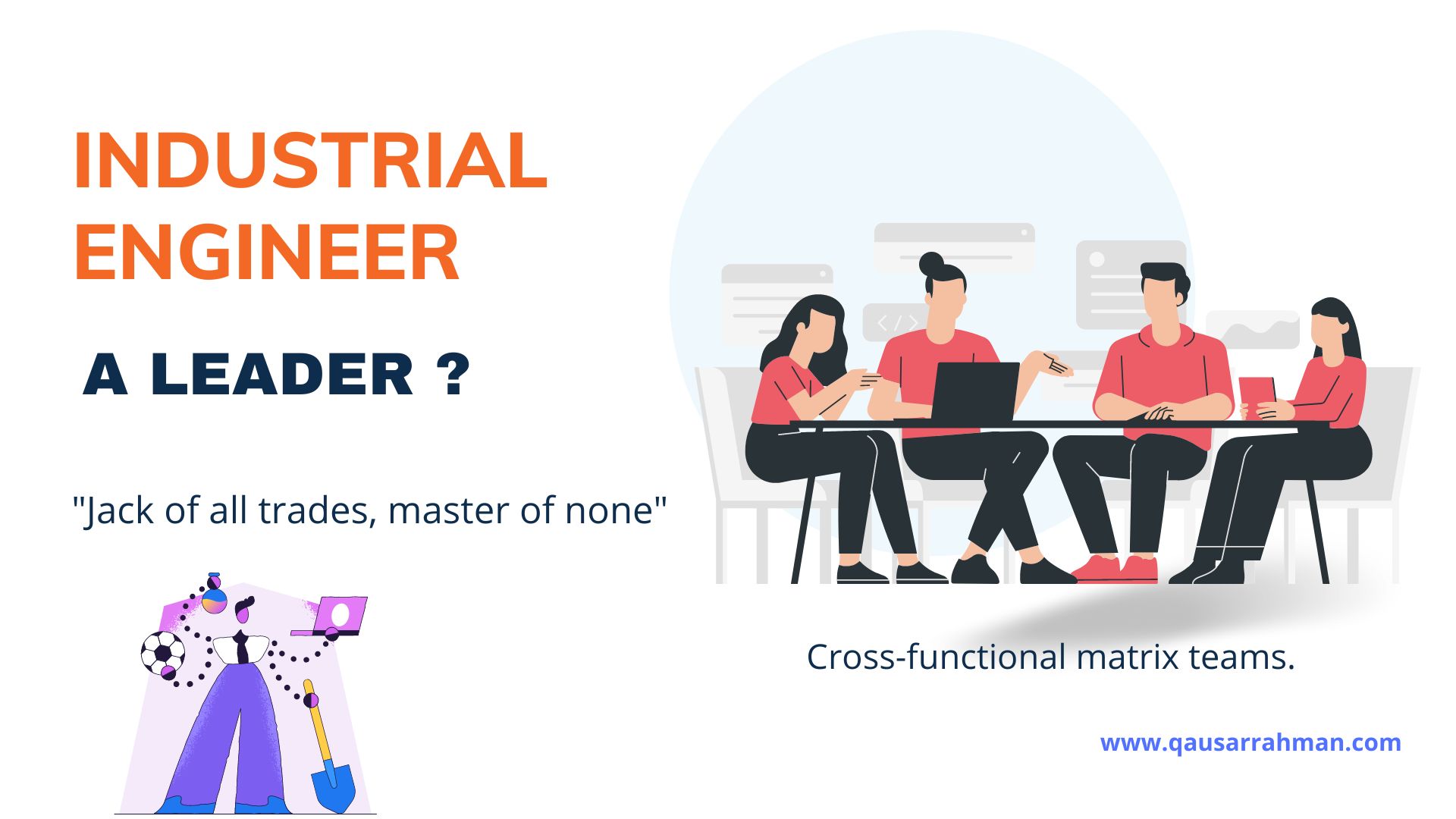
If you are an Industrial Engineer like I am, you've undoubtedly heard the phrase "What do you do?" a lot, right?
No matter whom you tell, people will typically inquire about your position inside an organization.
In terms of explaining what we do, the statement "we optimize resources by maintaining the same or higher output for an organization" is extremely general.
Industrial Engineers are, in my opinion, the most interesting individuals in the room. Regardless of his intelligence or subject matter expertise, he will be able to participate in any conversation regarding the business.
Due to specialized jargon, there is always a considerable risk of miscommunication among cross-functional teams operating within a matrix organization. In the case of project management, one of the most essential success factors is understanding the message provided to the stakeholders, whether they are senior executives, process owners, or project team members. If the noise is louder than the message, there is a greater likelihood of miscommunication, which could result in the failure of the project.
Why then did I consider an Industrial Engineer to be the most intriguing individual in the room?
Suppose you are a member of the purchasing department working on a project with a cross-functional team. You are describing how, based on your demand planning, you want to acquire a high quantity of raw materials due to seasonal considerations. There are representatives from Sales, Planning, Operations, Logistics, Maintenance, and Finance on the cross-functional team. It is possible that no one in the meeting is interested in your presentation since they are unfamiliar with demand planning and forecasting. If you meet someone who is interested in your issues and appreciates the significance of your work, you will consider them the most interesting person in the room.
Similarly, for the Planning Department, an Industrial Engineer who understands capacity planning, resource planning, etc. would continue to be the most intriguing person in the room for the Planning department employee.
Although an Industrial Engineer is known for work-study methods, he can also be involved in implementing a system through DMAIC, developing or re-engineering a system using DMADV, manufacturing simulation, etc. for the operations department, hence still be the most interesting individual in the room for him/her.
For the Logistics department, an industrial engineer is well-versed in transportation models. An Industrial Engineer is well-versed in EOQ, Handling cost, Safety Stock, Average Inventory, etc., and knows how to maintain the supply and demand function in the Inventory model.
For the Maintenance team, an Industrial Engineer is well-versed in the valves, compressors, pumps, and PLCs utilized in all machines. An Industrial Engineer is also familiar with all types of CNC machines, including routers, laser, and FDM. An Industrial Engineer is able to analyze or comprehend the issues associated with these machines. So that he can easily communicate with the Maintenance department's representative.
Industrial Engineers are also knowledgeable in cash flows, NPV, FV, budgeting, WBS for projects, resource allocation, depreciation, etc. Therefore, the interaction between an Industrial Engineer and a financial professional will be consistent with the terminology. Thus, even for a Finance professional, the most intriguing individual will be an Industrial Engineer.
Now, everyone may consider Industrial Engineers to be jacks of all trades and masters of none, but a cross-functional team with a matrix organization, which is a popular method for forming teams for any project, requires someone who understands the various jargon used by different departments to facilitate communication.
Therefore, an Industrial Engineer is ideal for leading projects in any firm. Industrial Engineers are equipped to manage projects involving multiple departments. Any solid Industrial Engineering course will cover all of the knowledge required to properly manage a project and establish an organization that is constantly evolving towards better systems with optimal resource usage.
So be the most interesting person in the room, gather everyone’s focus on one point and direct it to achieve bigger goals.